Dental Sealants
Board-Certified Specialists in Orthodontics and Pediatric Dentistry
located at: 12314 Potranco Rd, San Antonio, TX 78253.
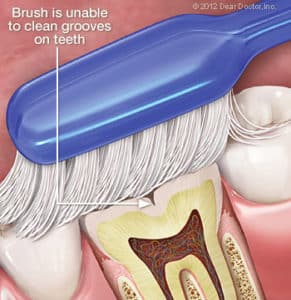 The most common place for a cavity to form in your child’s mouth is on the chewing surfaces of their back teeth. If you run your tongue over this area, you will notice why, unlike the smoother parts of your teeth, these surfaces have tiny natural grooves, known as “pits and fissures.” Bacteria and food particles can actively get trapped in these tiny cracks. Unfortunately, the bristles of a toothbrush often cannot reach deep into these narrow spaces, which makes them ideal spots for decay to begin.
Adding to the concern, a child’s newly erupted permanent teeth are naturally more vulnerable to decay. As we age, the enamel, which acts as an outer layer of protection, gets stronger. While fluoride, found in toothpaste, some drinking water, and professional dental treatments, helps harden enamel, it can be difficult to penetrate deep into those grooves regularly. Fortunately, there is an effective preventive option available: dental sealants.
Adding to the concern, a child’s newly erupted permanent teeth are naturally more vulnerable to decay. As we age, the enamel, which acts as an outer layer of protection, gets stronger. While fluoride, found in toothpaste, some drinking water, and professional dental treatments, helps harden enamel, it can be difficult to penetrate deep into those grooves regularly. Fortunately, there is an effective preventive option available: dental sealants.
How Sealants Are Placed
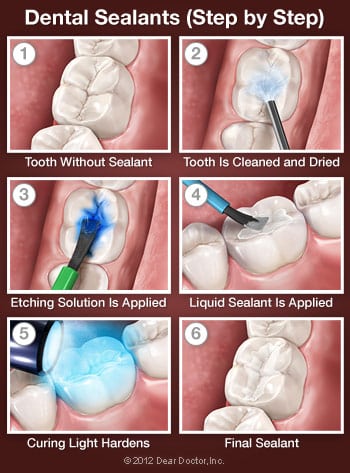
Sealants are tiny plastic fillings, though it is essential to let your child know that getting a sealant is not the same as having a cavity treated. Because the outer enamel of teeth contains no nerves, placing sealants is completely painless and usually does not require any numbing. First, we will carefully examine the teeth that need sealing, and if any minor decay is found, it will be gently removed. The tooth is then thoroughly cleaned and dried.
Next, we apply a special solution that slightly roughens the surface. This helps the sealant bond more securely. After rinsing and drying the tooth again, we paint on the liquid sealant. It hardens within a minute, often using a special curing light to assist the process. The procedure is quick, safe, and highly effective.
A quick word on BPA: In 2012, a study raised concerns about trace amounts of bisphenol-A (BPA) found in certain dental resins and their potential link to behavioral issues in children. While the study found a possible association, it did not prove a direct cause. In reality, BPA exposure from food and beverage packaging is significantly higher than from dental materials. Both the American Dental Association and the American Academy of Pediatric Dentistry continue to endorse the use of sealants. We are happy to discuss any questions or concerns you may have about this.
Taking Care of Sealants
Teeth that have been sealed still require the same daily care as any other teeth. Your child should maintain a regular brushing and flossing routine and continue coming in for professional cleanings. These visits allow us to check on the condition of the sealants, which can last up to 10 years with proper care. During that time, your child will benefit from a preventive treatment that has been shown to reduce tooth decay by more than 70 percent.
We proudly accept:
Most PPO Dental and Orthodontic Insurances!