Temporary Anchorage Devices/TADs
Board-Certified Specialists in Orthodontics and Pediatric Dentistry
located at: 12314 Potranco Rd, San Antonio, TX 78253.
Periodically, a new technology arises in dentistry and other specialties, promising to transform standard practice. TADS, or Temporary Anchorage Devices, aren’t necessarily new; orthodontists began using them in the 1980s, but they are enjoying new acceptance levels today. The advantages they give some patients undergoing orthodontic treatment might even be revolutionary. Let’s take a closer look at what these devices are, and what they can — or cannot — do.
TADs are small titanium alloy screws used in the mouth as dental implants. As the name suggests, they’re temporary — they have some months of treatment and then are removed. Their purpose is to deliver a solid anchorage — a fixed point around which other things (teeth, to be specific) may be moved. But to what end is anchorage so important?
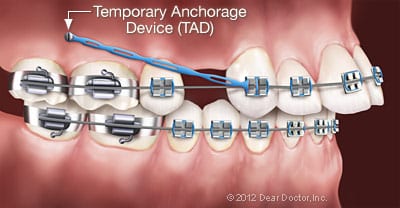
The teeth in the jaw are often compared to pushing a stick through sand, highlighting how challenging and resistant the process can be. Force, and the sand shifts away in front of the stick, taking up the void behind. In this case, the “sand” refers to bone and periodontal ligament cells that anchor the tooth to the bone. These tissues gradually give way and recast themselves as orthodontic appliances (wires and elastics) push the teeth against them.
But that force does require a fixed point to push against if it is to do its work. For instance, try to waggle the stick around with you floating free in the water: Not too easy! However, you can move forward when standing with both feet solidly on the sand. Orthodontists usually focus on anchoring as much as possible on the back teeth, but occasionally they use headgear to gain extra support for the rear teeth. Having TADS will often turn that on its head.
What TADS Can Do
Although this is the preferred method, there are some cases in which moving teeth is not optimal for anchorage. For instance, an anchor may be required, but there simply isn’t a suitable tooth in that location. Additionally, when a greater force is applied, the teeth serving as anchors may begin to move. This is where TADS are particularly useful: these mini-implants can help avoid relying on teeth as anchors during treatment or assist in stabilizing a tooth being used as an anchor.
TADS can serve as an anchor for applying force instead of external devices like headgear, which can cause discomfort and compliance issues and can be costly, bulky, and embarrassing. TADS can often help you avoid wearing headgear, making things more comfortable and convenient.
There are other advantages to using TADS: It may reduce the need for a longer course of treatment, shorten the time that elastics need to be worn, eliminate the need to wear elastics (rubber bands) at all, and, in some cases, allow certain oral surgeries to be avoided. It also enables orthodontists to treat complex cases that used to be nearly impossible to treat. This little thing can be huge!
Getting (and Maintaining) TADS
TADS are small screw-like devices that are gently placed through the jawbone, similar to dental implants. They have been trusted for many decades. Unlike implants, TADS don’t always fuse with the bone but can be secured mechanically. They are also easier to insert and remove after treatment. How easy?
Implanting and removing TADS is a simple, painless process. After numbing the treatment area with an injection or other method, patients feel only gentle pressure as the device is inserted. The entire procedure can be completed in just a few minutes. An over-the-counter pain reliever can be taken afterward if needed, though many patients don’t require any pain medication. Removing TADS is even simpler. So if you’re worried it will be painful, relax! It’s easier than you might believe.
Once in place, TADS requires little maintenance. To keep his teeth healthy, he should brush his teeth twice a day, once in the morning and once at night, dipping the toothbrush in an antimicrobial solution. When your TADS are inserted, we will tell you exactly how to maintain them.
TADS is not required for every orthodontic patient, but this form of treatment has some notable advantages for a subset of patients who can benefit from it.
We proudly accept:
Most PPO Dental and Orthodontic Insurances!